Friday, February 09, 2018

Fiordland National Park

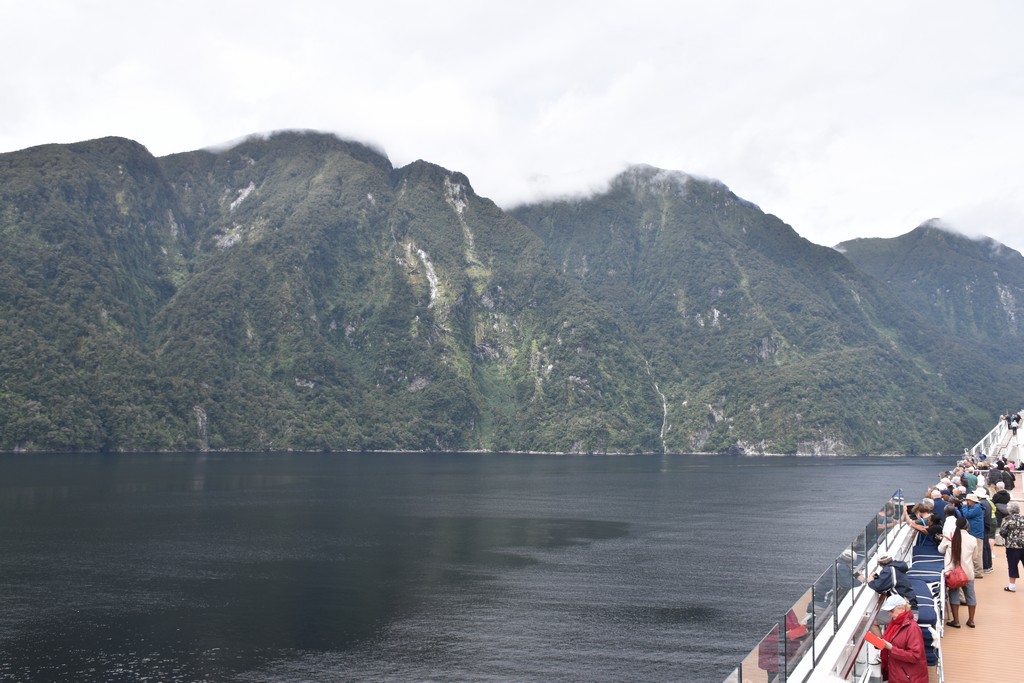
After two days at sea "crossing the ditch" from Tasmania, we have arrived at the southwest corner of New Zealand. European settlers were not familiar with the term "fiord", so they named these inlets Milford Sound, Thompson Sound, Doubtful Sound, etc.  But they are true fiords, which are defined as glacially carved valleys later filled in by the sea.  According to Maori legend, this area was carved out by a demi-god, Tute Rakiwhanoa, with a giant stone adz.


At 7:00 a.m., we arrived at the entrance of Milford Sound.  The peaks along the side average 1200 m in height (4000 feet) and the average water depth is 250 m (800 feet).  Our on board naturalist, Chelsea Behymer, provided commentary from the bridge which was broadcast throughout the ship.  The weather was clear and cool with higher than usual cloud cover.  The water was flat as glass.  We were told that this perfect weather is unusual for the area.


Stirling Falls travels 155 m (500 feet) into the water.  Bowen Falls at the base of Mitre Peak is 163 m high.


The top of Mount Pembroke with its snowy Pembroke glacier was fully visible.  This is the case only 25% of the time.


The hillsides are forested with beech trees which are resistant to the variable weather conditions in the area.  These trees have a shared lineage with the forests of Patagonia and Chile, reinforcing the geological history of the area showing that New Zealand broke away from the coast of South America.  Visible scarring on the granite hillsides is due to landslides and glacial action.


Leaving Milford Sound, we travelled along the mainland to the entrance of Thompson Sound, leading into Doubtful Sound.  Captain Cook named this sound because he was reluctant to travel into it, unsure that he would ever find his way out.


On average, rain falls more than two hundred days each year.  Therefore there is a permanent freshwater layer sitting on top of the salt water in the fiord.  The beech tree leaves leach tannins into the water giving it a very dark, almost black, colour.  Very little light penetrates into the sea water layer.  This creates a "deep water" sea habitat within diving depth allowing scientists to study these unique organisms.

By mid afternoon we entered Dusky Sound, so named by Captain Cook because of its somber, wet, cloudy conditions.  But not today, as the sun broke through the clouds. This is the largest of the sounds with many islands.  It is also very remote, only accessible by boat or on foot.  One of the largest islands is Resolution Island.
The forests of New Zealand were originally inhabited by insects, reptiles and birds - no mammals except fur seals and bats.  The birds thrived and became very large.  Many of them lost the ability to fly and wandered the forest floor with no predators.  The now extinct Moa reached a weight of 440 kg (900 lb).   Eventually, New Zealand was settled by Polynesians, 600 - 800 years ago. They cultivated crops and hunted birds for food. Then Europeans brought grazing livestock, new plants and some mammals like stoats and rats which were very destructive to the defenseless birds. Now Resolution Island has been set aside as a wildlife refuge to re-establish the very unique native species and prevent further extinction.

We get excited when we are kayaking and see half a dozen dolphins. We were thrilled to be joined by about 60 bottle nosed dolphins along the side of the ship who put on quite a show.


Wednesday, February 07, 2018

A Day in Tasmania

Tasmania is an island state of Australia and Hobart is the state capital and most populous city of 200,000.  The whole island has a population of around 500,000.  Tasmania was founded in 1803 as a penal colony.  Today Hobart is the financial and administrative heart of Tasmania and also serves as the home port for both Australian and French Antarctic operations.


Tasmania exports fish, abalone, oysters, fruits and vegetables, wheat, oats and 40% of the world's opiates for pharmaceutical use.  There is an active wine industry with more than 100 Cellars.


Our tour began at the Bonorong Wildlife Sanctuary.  "Bon-a -rong" is an Aboriginal word meaning "native companion". It was established in 1981 as a sanctuary for injured and orphaned wildlife.  It is home to many animals including wombats, koalas, Tasmanian devils, quolls, echidnas, and free roaming kangaroos who enjoy a scratch on the chest and some hand held food.  A group of kangaroos is called a "mob".


The Tasmanian devil cannot be mistaken for any other marsupial. Its spine chilling screeches, black colour and reputed bad temper led early European settlers to call it "the devil." The devil is mainly a scavenger and eats whatever is available.  Its powerful jaws and teeth allow it to completely devour its prey - bones, fur and all.  Sadly, in the last ten years, a cancer has decimated the population. Large tumours on the neck and face affect the teeth, inhibit feeding and those infected die within 6 months.  Scientists are isolating healthy devils to breed in captivity to maintain the species.


After a short drive through the countryside we went to the municipality of Richmond.  We drove across the oldest bridge in Australia "still in use" which fortunately was able to hold two busloads of tourists at one time,  We also saw the oldest Roman Catholic church and school still in operation.  The early settlers used convict labour on their farms and had the convicts build a jail to house them at night.


For such a small population, Tasmania has a thriving economy and is also becoming popular as a tourist destination.  Three of four people own some sort of watercraft.  From our balcony we can see sailboats, sea-doos, kayaks, kite powered surfers, powerboats, ferries, tug boats, fishing boats and cruise ships.  The Holland American Noordam is docked next to us.


Tuesday, February 06, 2018

The Celebrity Solstice

Today Jack took a "Behind the Scenes Tour" of the ship. The Celebrity Solstice has 2850 guests and a crew of 1200. The sailors are all Greek. The cabin attendants are mainly from India and the South Sea Islands. Cooks and dining staff are Hispanic and from former republics of the Soviet Union.

The ship is over 1000 feet long and 120 feet wide. It is propelled by two electric propulsion pods which are located in the stern. The power for these motors is provided by four huge electric generators which are attached to four V-16 diesel engines. Normally only three generators are in operation but the ship can still achieve a speed of 24 knots.

Below are some photographs from the tour.
Navigational Bridge
Control Panel for all Propulsion
View toward the bow
Helipad with crew outdoor bar
View aft from wing on bridge
All interior spaces were immaculate
Laundry operates 24/7
Folding Linens
More Washing Machines

Corridor runs entire length of ship
A busy street
Notice sign
All metal & glass is recycled
Glass is sorted by colour
Recycling profits goes to crew 
Tons of food supplies
Cheese and Milk
Main dining room
Waiters picking up food
Menus for all 14 days of cruise
We are all having fun

Sunday, February 04, 2018

Superbowl Monday Morning in Melbourne

According to our dinner companions last night, Melbourne has many times been voted the most livable city on earth. This morning we arrived at the wharf to a beehive of activity.  As our ship docked, another cruise ship was following us into the other side of the pier. Dozens of vehicles, including RV's were loading onto a large ferry bound for Tasmania 10 hours away.


Melbourne should be called the city of trams. All trams in the central business district are free In total
there are 250 kilometers (160 miles), about 500 trams, 24 routes, and more than 1700 tram stops.  In order to get from the pier to downtown, we purchased a MYKI card which allows access to routes outside the city centre by tapping on and off. From Flinders Street station we took the City Circle Tram #35 around the perimeter of the city centre with commentary.  This tram was from the Victorian era.


As we will be returning to Melbourne at the end of the cruise portion of our trip, we walked a bit, then took tram 109 back to the pier after a brief stop at a Victorian toilet on Flinders street.

First Day at Sea

We awoke this morning to a bright and sunny day with a very slight chop on the water (wave height one metre). After breakfast we made our way to the uppermost deck where we sat under huge white canvas awnings to watch a glass blowing demonstration. The Corning Museum of Glass has created a complete glass blowing studio where three very talented young artists demonstrated the making of various art works.


x

The rest of the afternoon was spent exploring the ship and napping.